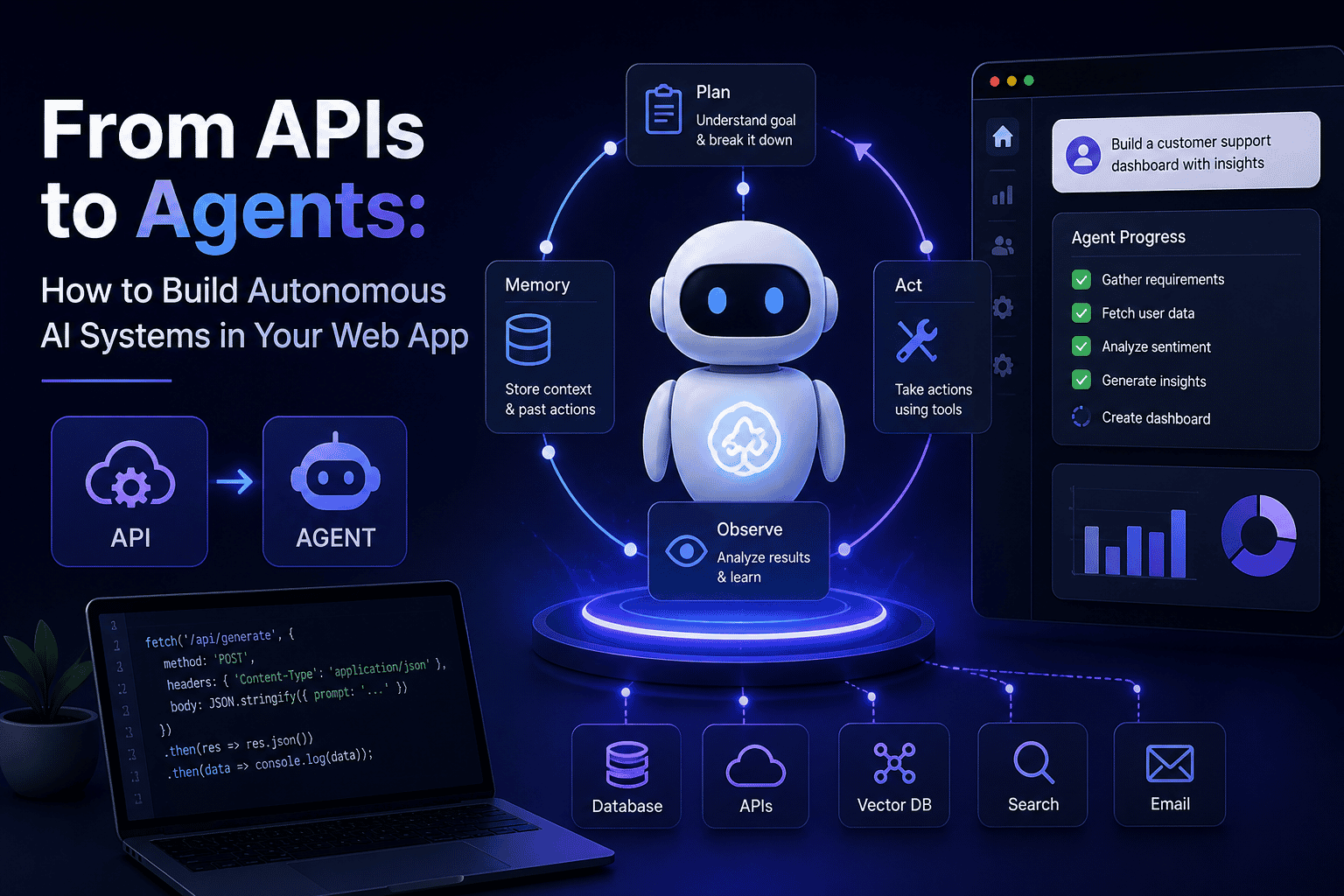
The landscape of web application development is undergoing a profound transformation, driven by the rapid advancements in artificial intelligence. While traditional AI integration often involved stateless API calls to large language models (LLMs) for specific tasks like text generation or sentiment analysis, a new paradigm is emerging: autonomous AI agents. These agents transcend simple API interactions by possessing capabilities such as memory, planning, tool utilization, and the ability to self-correct, enabling them to pursue complex, multi-step goals without constant human intervention. This shift from mere API consumption to building truly intelligent, self-directed systems within web applications represents a significant leap forward, promising unprecedented levels of automation, personalization, and user experience. Understanding how to architect and implement these sophisticated agents is becoming a critical skill for modern developers and businesses aiming to stay at the forefront of innovation.
The Evolution from APIs to Agents: A Paradigm Shift
For years, integrating AI into web applications primarily revolved around consuming pre-trained models via APIs. Developers would send a prompt to an LLM API, receive a response, and then programmatically handle the subsequent logic. This approach, while effective for discrete tasks, lacked the continuity and adaptive intelligence required for more complex, long-running processes. Each API call was typically independent, with no inherent memory of previous interactions or a proactive ability to plan future actions. This stateless interaction model placed the burden of orchestration entirely on the developer, limiting the "intelligence" to the immediate response rather than an evolving, goal-oriented system.
The advent of autonomous agents marks a fundamental shift away from this reactive, stateless model. An agent, in this context, is an AI system designed to perceive its environment, form plans, execute actions, and learn from the outcomes, all with the ultimate goal of achieving a defined objective. Unlike simple API calls, agents maintain a persistent state, possess a form of memory, and can leverage external tools to interact with their environment. This enables them to tackle problems that require multiple steps, adapting their approach based on real-time feedback and internal reasoning. Building agents into web applications means embedding a proactive, problem-solving entity directly into the user experience, capable of handling intricate workflows and dynamic user needs.
Core Components of an Autonomous AI Agent
To construct a truly autonomous AI agent, several interconnected components must work in harmony, each contributing to the agent's ability to perceive, reason, and act. Understanding these foundational elements is crucial for designing robust and intelligent systems. These components provide the blueprint for an agent's operational capabilities, allowing it to move beyond simple input-output functions to engage in complex problem-solving and adaptive behavior within a web application context. The synergy between these parts is what ultimately defines an agent's autonomy and effectiveness in diverse scenarios.
Perception and Observation: Understanding the Environment
An agent's ability to observe its environment is its primary input mechanism. In a web application context, this might involve processing user inputs, monitoring database changes, parsing web page content, or receiving data from other services. This component translates raw data into a structured format that the agent can understand and use for reasoning. Effective perception ensures the agent has an accurate and up-to-date understanding of the current state of its operational environment. For instance, an agent assisting with e-commerce might perceive a user's browsing history, items in their cart, and recent searches to tailor recommendations.
Memory: Retaining Context and Learning
Memory is arguably one of the most critical differentiators between a simple API call and an autonomous agent. Agents require both short-term and long-term memory. Short-term memory, often implemented as a context window in LLMs, holds recent interactions and observations relevant to the current task. Long-term memory, typically powered by vector databases, stores past experiences, learned facts, and acquired knowledge, allowing the agent to recall information over extended periods and across different sessions. This persistent memory enables the agent to maintain conversational coherence, learn from past mistakes, and apply previously acquired knowledge to new situations, leading to more intelligent and personalized interactions.
Planning and Reasoning: Strategizing for Goals
The planning component allows an agent to break down a complex, high-level goal into a series of smaller, executable steps. This involves leveraging its internal knowledge and current observations to devise a strategic sequence of actions. Reasoning, often powered by an LLM, evaluates potential actions, predicts their outcomes, and chooses the most optimal path to achieve the objective. This iterative process of planning and re-planning is what gives agents their adaptability and problem-solving prowess. For example, an agent tasked with booking a flight might plan to first search for flights, then check prices, then find accommodations, and finally present options to the user, adjusting its plan based on real-time availability and user preferences.
Tool Use and Action Execution: Interacting with the World
Agents are not confined to their internal reasoning; they can interact with the external world through a set of predefined "tools." These tools can be anything from calling external APIs (e.g., a weather API, a database query, a CRM system), sending emails, generating code, or even interacting with other parts of the web application's UI. The agent's reasoning component decides which tool to use at which step of its plan. The action execution component then invokes the chosen tool and processes its output, which feeds back into the agent's perception and memory for subsequent planning cycles. This ability to use tools dramatically expands an agent's capabilities, allowing it to perform real-world tasks that go beyond simple text generation.
Designing the Agent Architecture for Web Apps
Integrating autonomous AI agents into web applications requires a carefully considered architectural design that accommodates their unique operational requirements. Unlike traditional monolithic or microservices architectures that primarily focus on data flow and user interfaces, agent-centric architectures must also account for continuous reasoning, state management, and external tool interactions. This typically involves a layered approach that separates concerns while facilitating seamless communication between the agent's core intelligence and the web application's functionalities, ensuring scalability, reliability, and an intuitive user experience. The design choices made at this stage will significantly impact the agent's performance and the overall responsiveness of the web application.
Frontend Integration: User Interaction and Visualization
The frontend serves as the primary interface through which users interact with the autonomous agent. This involves designing intuitive chat interfaces, dynamic dashboards, and visual feedback mechanisms that communicate the agent's current status, ongoing actions, and progress towards a goal. Real-time updates are crucial, often leveraging WebSockets or server-sent events to push agent actions and outputs to the user interface immediately. Considerations include how users can initiate tasks, provide feedback, interrupt the agent, or view its "thought process." A well-designed frontend ensures that users feel in control and can understand the agent's capabilities and limitations, fostering trust and engagement with the autonomous system.
Backend Orchestration: The Agent's Operating System
The backend is where the core logic of the autonomous agent resides, managing its lifecycle, memory, planning, and tool execution. This layer typically involves a server-side framework (e.g., Node.js, Python/Django/Flask, Go) that hosts the agent's reasoning engine (often an LLM wrapper), memory store (e.g., vector database, key-value store), and a registry of available tools. The backend orchestrates the flow of information between the agent's components, handling incoming requests from the frontend, invoking external APIs as tools, and managing the agent's persistent state. Robust error handling, retry mechanisms, and logging are essential here to ensure the agent's reliability and debuggability in complex, multi-step operations.
Agent State Management: Persistence and Resilience
Autonomous agents are inherently stateful; they need to remember their current task, previous steps, and learned information. Effective state management is critical for agents to operate reliably over time and across sessions. This involves persisting the agent's internal state (e.g., current plan, memory contents, tool outputs) to a durable storage solution, such as a database. When an agent is paused or the application restarts, its state can be reloaded, allowing it to resume its task seamlessly from where it left off. This resilience ensures that long-running tasks are not interrupted by transient failures and that the agent can maintain a continuous, intelligent interaction with the user. Designing for efficient state serialization and deserialization is key.
Memory Management for Persistent Intelligence
Memory is the cornerstone of an intelligent agent, enabling it to go beyond reactive responses and engage in context-aware, long-term interactions. Effective memory management is not just about storing information but also about retrieving relevant context efficiently and integrating new learning. Autonomous agents require sophisticated memory systems that can handle various types of information and recall it appropriately based on the current task and ongoing dialogue. Without robust memory, an agent would effectively restart its understanding with every interaction, severely limiting its utility and perceived intelligence within a dynamic web application environment.
Short-Term Memory: Context Window and Ephemeral Recall
Short-term memory, often synonymous with the context window of an LLM, is crucial for maintaining conversational coherence within a single interaction or a short series of exchanges. This memory holds recent turns of a conversation, immediate observations, and intermediate results of the agent's current task. It's typically transient and designed for fast access, allowing the LLM to understand the immediate context and generate relevant responses or actions. Managing the size of this context window is important, as larger windows increase processing costs and latency, while smaller ones risk losing vital information. Techniques like summarization or selective pruning can help keep the short-term memory concise and relevant.
Long-Term Memory: Vector Databases and Semantic Retrieval
For persistent knowledge and recall across sessions or extended periods, long-term memory is indispensable. This is typically implemented using vector databases (e.g., Pinecone, Weaviate, ChromaDB) that store embeddings of past experiences, learned facts, user preferences, and domain-specific knowledge. When the agent needs to recall information, it queries the vector database using the embedding of the current context, retrieving semantically similar memories. This allows the agent to access a vast store of information, learn from past interactions, and provide highly personalized and informed responses. The efficiency and accuracy of semantic retrieval directly impact the agent's ability to demonstrate deep understanding and adaptive behavior.
Memory Augmentation and Learning: Continual Improvement
Autonomous agents should ideally learn and improve over time. Memory augmentation involves mechanisms to continuously update the agent's long-term memory with new information derived from its experiences, user feedback, or external data sources. This could include storing successful action sequences, user preferences, common problem-solving patterns, or new facts encountered during its operation. Techniques like reinforcement learning from human feedback (RLHF) or self-reflection prompts can be used to refine the agent's knowledge and decision-making processes, ensuring that the agent's intelligence grows and adapts to evolving requirements and new data, making it more effective and robust over its lifespan.
Tool Integration and Function Calling: Extending Agent Capabilities
A key differentiator for autonomous agents is their ability to leverage external tools, transforming them from mere conversational interfaces into active participants in the digital ecosystem. Tool integration, often facilitated through "function calling" capabilities of modern LLMs, allows agents to perform actions in the real world, retrieve up-to-date information, and interact with other systems. This capability is what truly enables agents to move beyond text generation and become powerful automation engines within a web application. The design of these tools and the methods for their invocation are critical for an agent's efficacy and versatility.
Defining Agent Tools: APIs as Actionable Functions
Tools are essentially functions or API endpoints that the agent can call to perform specific tasks. These can include anything from querying a database, fetching real-time stock prices, sending an email, interacting with a CRM system, generating an image, or even manipulating UI elements within the web application itself. Each tool needs a clear, descriptive schema (e.g., JSON schema) that outlines its purpose, required parameters, and expected output. This schema acts as a contract, allowing the LLM to understand when and how to invoke a particular tool, based on its current goal and the available context. Developers define these tools, essentially creating an API for the AI agent to use.
Function Calling and Orchestration: Agent-Tool Interaction
The process of an agent using a tool typically involves the LLM generating a "function call" rather than a direct response. When the LLM determines that an external action is needed to fulfill a user's request or its own plan, it generates a structured call to one of its predefined tools, including the necessary parameters. The agent orchestration layer intercepts this function call, executes the corresponding tool (e.g., makes an API request), and then feeds the tool's output back to the LLM. The LLM then processes this output, incorporates it into its memory, and continues its reasoning or generates a user-facing response. This iterative loop of reasoning, tool-calling, and observation is central to agentic behavior.
Handling Tool Output and Error Management
Once a tool has been executed, its output must be processed effectively by the agent. This involves parsing the results, extracting relevant information, and integrating it back into the agent's context and memory. Equally important is robust error management. Tools can fail due to network issues, invalid parameters, or external service outages. The agent architecture must include mechanisms to detect these failures, notify the agent, and potentially trigger alternative plans or retry mechanisms. The agent should be able to reason about errors, learn from them, and adapt its future tool usage, preventing a single tool failure from derailing an entire complex task. This resilience is vital for reliable autonomous operations.
Implementing Agentic Reasoning and Decision-Making
The true intelligence of an autonomous agent lies in its capacity for reasoning and decision-making. This is where the core LLM acts as the agent's "brain," processing information, formulating plans, and choosing actions. Implementing effective reasoning involves more than just sending a prompt; it requires careful consideration of prompting strategies, iterative refinement, and mechanisms for self-correction. The goal is to enable the agent to think critically, adapt to unforeseen circumstances, and make choices that align with its overarching objectives, even in complex and ambiguous situations within the web application environment.
Prompt Engineering for Agent Behavior: Guiding the AI
The quality of an agent's reasoning is heavily dependent on the prompt engineering applied to the underlying LLM. This involves crafting system prompts that define the agent's persona, its goals, its capabilities, and the instructions for its behavior. For autonomous agents, prompts often include explicit instructions for planning, tool selection, reflection, and output formatting. Techniques like few-shot learning, where examples of desired behavior are provided, can significantly improve the agent's ability to follow complex instructions and perform multi-step tasks. Clear, concise, and comprehensive prompts are the foundation for consistent and intelligent agent performance, acting as the agent's core directive.
Iterative Planning and Reflection: Self-Correction Mechanisms
A hallmark of sophisticated autonomous agents is their ability to engage in iterative planning and reflection. Instead of executing a fixed plan, agents can dynamically generate a plan, execute a step, observe the outcome, and then reflect on whether the outcome aligns with the plan and the overall goal. If deviations occur or better paths are identified, the agent can self-correct by revising its plan. This reflective capability, often prompted by asking the LLM to critique its own actions or outcomes, allows agents to recover from errors, adapt to changing environments, and continually refine their strategy. This mechanism is crucial for navigating the uncertainties inherent in real-world web application interactions.
Balancing Autonomy and Human Oversight
While the goal is autonomy, it's often prudent to design agents with a degree of human oversight, especially in critical applications. This could involve "human-in-the-loop" mechanisms where the agent asks for confirmation before executing high-impact actions, or where human operators can monitor agent activity and intervene if necessary. Striking the right balance between full autonomy and controlled intervention is key to building trustworthy and reliable systems. The agent's reasoning should include decision points where it determines if human input is required, ensuring that complex or sensitive operations are handled with appropriate caution and accountability, enhancing safety and user confidence.
Building the User Interface for Agent Interaction
The user interface (UI) is the bridge between the complex intelligence of an autonomous agent and the end-user. A well-designed UI not only facilitates interaction but also builds trust, clarifies the agent's capabilities, and makes its autonomous processes transparent. For web applications embedding agents, the UI needs to be more dynamic and informative than traditional interfaces, providing insights into the agent's ongoing work rather than just displaying static content or simple responses. This involves careful consideration of how to represent the agent's "thinking" process and its interaction with various tools.
Interactive Chat Interfaces: The Primary Interaction Model
For many autonomous agents, an interactive chat interface will serve as the primary mode of communication. This goes beyond simple question-and-answer bots; it needs to support multi-turn conversations, allow users to initiate complex tasks, provide clarifications, and receive updates on task progress. Features like typing indicators, message history, and rich message formats (e.g., cards, buttons, embedded media) enhance the user experience. The UI should also allow users to input structured data when needed, not just free-form text, enabling the agent to gather precise information for its tasks. This makes the interaction feel more natural and intuitive, akin to collaborating with a human assistant.
Visualizing Agent State and Progress: Transparency and Trust
One of the challenges with autonomous agents is their "black box" nature. To build trust and allow users to understand what the agent is doing, it's critical to visualize its internal state and progress. This could involve displaying a step-by-step breakdown of the agent's plan, highlighting the current action being executed, showing which tools are being used, and providing real-time updates on task completion. A progress bar, a list of completed sub-tasks, or even a textual summary of the agent's current "thought process" can significantly improve user comprehension and confidence. Transparency helps users feel more in control and less intimidated by the agent's autonomy, fostering a collaborative relationship.
Human-in-the-Loop Controls: Empowering User Intervention
Even highly autonomous agents can benefit from human oversight and intervention. The UI should provide clear mechanisms for users to pause, stop, or redirect the agent. This might include "cancel" buttons for ongoing tasks, options to provide specific instructions or corrections mid-task, or a way to escalate an issue to a human operator. For critical tasks, the UI could present the agent's proposed action for user confirmation before execution. These human-in-the-loop controls are essential for safety, ensuring that users retain ultimate control and can correct the agent if it deviates from their intent or encounters an unexpected situation, thereby enhancing the overall reliability and accountability of the system.
Deployment, Scaling, and Monitoring Autonomous Agents
Bringing autonomous AI agents from development to production in a web application environment involves addressing significant challenges related to deployment, scalability, and ongoing performance monitoring. These agents, with their stateful nature, complex dependencies, and continuous reasoning, require a robust infrastructure that can support their unique operational demands. Ensuring reliability, cost-effectiveness, and responsiveness at scale is paramount for the successful integration and long-term viability of agent-powered features in any production web application. Careful planning in these areas is crucial to avoid bottlenecks and ensure a seamless user experience.
Infrastructure for Agent Orchestration: Cloud and Containers
Deploying autonomous agents typically involves cloud-based infrastructure (AWS, Azure, GCP) due to the computational demands of LLMs and vector databases. Containerization technologies like Docker and orchestration platforms like Kubernetes are ideal for managing agent instances, providing scalability, fault tolerance, and efficient resource utilization. Each agent might run as a separate service or a collection of microservices, allowing for independent scaling of different components (e.g., memory service, tool execution service). Serverless functions can also be employed for stateless tool invocations, offering cost efficiency for bursty workloads, while dedicated instances handle the more persistent reasoning components. This flexible infrastructure is key to handling varying demands.
Scaling Agent Instances and Memory Stores
As user demand grows, the ability to scale agent instances and their associated memory stores becomes critical. Horizontal scaling, where multiple agent instances run in parallel, is common, but careful consideration must be given to how memory is shared or partitioned across instances. Vector databases and other persistent memory stores must also be designed for high availability and scalability, often leveraging distributed database architectures. Load balancing ensures that incoming requests are distributed efficiently across agent instances, maintaining responsiveness. Strategies for efficient memory caching and data partitioning can further optimize performance and reduce latency under heavy load, ensuring a consistent user experience even during peak usage.
Monitoring and Observability: Ensuring Agent Health
Monitoring autonomous agents in production is more complex than traditional web services, as it involves tracking not just system metrics (CPU, memory, network) but also agent-specific metrics. This includes monitoring the number of active agents, their task completion rates, tool invocation success/failure rates, LLM token usage, and latency for reasoning steps. Observability tools should provide detailed logs of agent decisions, plans, and tool outputs, allowing developers to debug issues and understand agent behavior. Alerting systems should be in place to flag anomalies, such as agents getting stuck in loops or frequent tool failures, enabling proactive intervention and ensuring the agent's continuous, reliable operation and overall health.
Challenges and Best Practices in Agent Development
Building autonomous AI systems is a nascent field, and as such, it comes with a unique set of challenges that developers and organizations must navigate. From ensuring the reliability of agent decisions to managing the costs associated with advanced AI models, these hurdles require thoughtful strategies and adherence to best practices. Addressing these challenges proactively is essential for developing agents that are not only powerful but also responsible, efficient, and trustworthy, thereby maximizing their positive impact within web applications and minimizing potential risks or negative outcomes for users and businesses alike.
Ensuring Reliability and Reducing Hallucinations
One of the primary challenges with LLM-powered agents is ensuring reliability and mitigating "hallucinations" – instances where the agent generates factually incorrect or nonsensical information. Best practices include grounding the agent's responses in retrieved facts from its long-term memory or external tools, rather than relying solely on the LLM's parametric knowledge. Implementing confidence scores, cross-referencing information with multiple sources, and allowing for human review of critical outputs can further enhance reliability. Designing robust error handling for tool failures and providing mechanisms for the agent to recover gracefully from unexpected situations are also crucial for maintaining a high level of operational integrity and user trust.
Cost Optimization for LLM and Vector Database Usage
Running autonomous agents can be resource-intensive, particularly due to the computational costs associated with frequent LLM calls and vector database operations. Cost optimization is a significant consideration. Strategies include optimizing prompt length, using smaller